Growing up, the week before Raksha Bandhan always smelled like roasted besan in our house – my mother would stand at the stove for what felt like forever, stirring gram flour in ghee until the whole kitchen turned warm and nutty. She’d let me roll the ladoos once they cooled just enough to handle, and I always ate at least two “for quality control” before they made it to the plate. With Rakhi coming up on August 28 this year, it felt like the right time to finally write her recipe down properly.
What is Besan Ladoo?
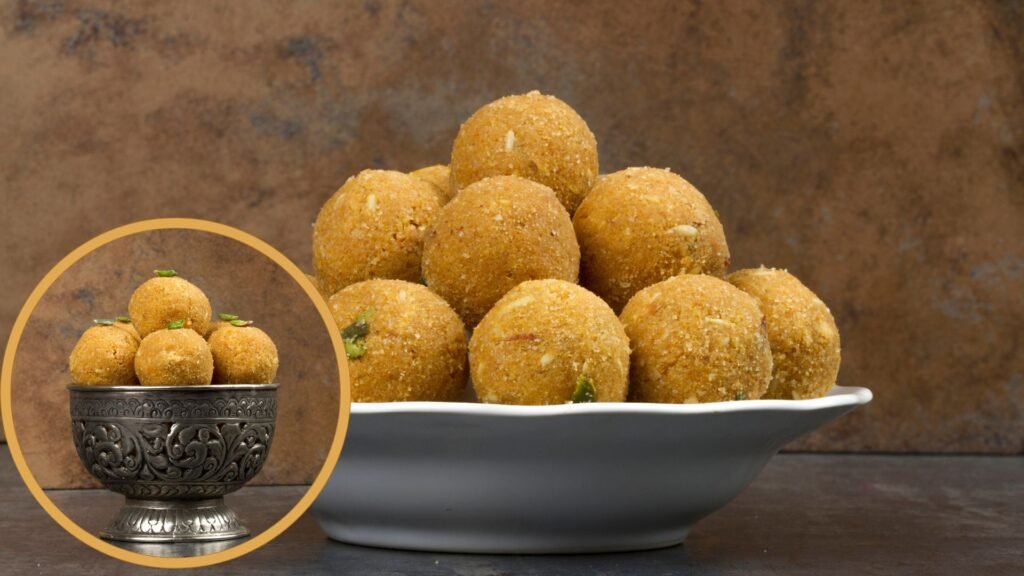
Besan ladoo is a round, melt-in-the-mouth sweet made from roasted gram flour (besan), ghee and sugar, usually studded with chopped nuts. The magic is entirely in the roasting – done right, the raw, slightly bitter smell of gram flour transforms into something deeply nutty and fragrant, which is what gives besan ladoo its distinctive flavor.
Where Besan Ladoo Comes From
Besan ladoo is a North Indian classic, especially popular in Punjab, Rajasthan and Uttar Pradesh, and it’s one of the most common sweets exchanged during Raksha Bandhan, when sisters tie a rakhi on their brothers’ wrists and sweets are shared as part of the ritual. It also shows up at Diwali and weddings, but its association with Rakhi is especially strong since it keeps well at room temperature and travels easily useful when sisters are sending sweets to brothers who live far away.
Health Benefits of Besan (Gram Flour)
- Besan is made from ground chickpeas, so it carries more protein and fiber than refined wheat flour
- It has a lower glycemic index than maida (refined flour), meaning a slower, steadier impact on blood sugar
- Roasting in ghee rather than deep frying keeps the fat content more moderate for a sweet
- Ghee itself, used in moderation, supports absorption of fat-soluble vitamins and is easier to digest than many refined oils
Ingredients:
- 2 cups besan (gram flour), preferably coarse-ground
- 3/4 cup ghee
- 3/4 cup powdered sugar
- 1/4 cup mixed nuts (almonds, cashews), finely chopped
- 1/4 tsp cardamom powder
- A pinch of salt
Instructions:
Step 1: Melt the ghee
Heat ghee in a heavy-bottomed pan on low-medium heat until fully melted.
Step 2: Roast the besan
Add the besan and roast on low heat, stirring continuously, for 15-20 minutes. The color will slowly deepen from pale yellow to a light golden brown, and the raw smell will disappear. Patience here is everything, since rushing on high heat will burn the besan before it’s properly roasted.
Step 3: Cool the mixture
Transfer the roasted besan to a wide plate or tray and let it cool until just warm to the touch, about 15-20 minutes. Adding sugar while it’s too hot will melt it and make the ladoos sticky instead of grainy-soft.
Step 4: Add sugar and nuts
Once warm, mix in the powdered sugar, chopped nuts, cardamom powder and salt until evenly combined.
Step 5: Shape the ladoos
While the mixture is still warm enough to hold together, take small portions and roll firmly between your palms into round ladoos. If the mixture feels too dry to bind, add a teaspoon of warm ghee.
Tips:
Use coarse besan (sometimes labeled “motta besan”) rather than fine besan if you can find it. It gives a better texture. Roast low and slow; if you smell any hint of bitterness, it’s likely under-roasted, not over-roasted. Store in an airtight container and these will easily keep for 2-3 weeks at room temperature, which makes them perfect for gifting on Rakhi.
For more such quick recipes, visit my YouTube channel @qwikrecipes. If you like the recipe, do like, comment and subscribe.