What is Panjiri?
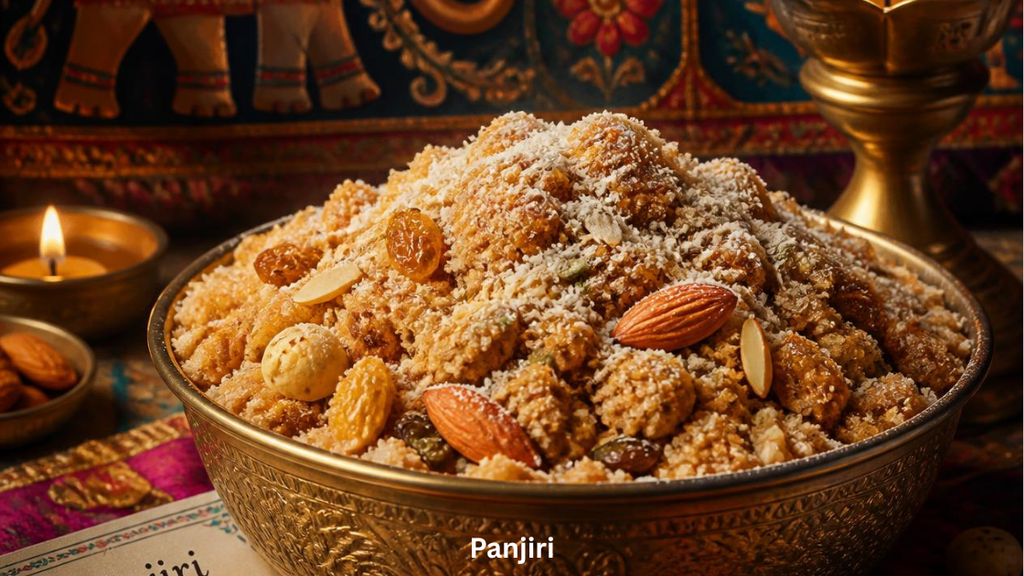
Panjiri is a dry, crumbly North Indian sweet made by slow-roasting whole wheat flour (or sometimes gond, edible gum resin) in ghee until deeply fragrant. It is then mixed in powdered sugar, roasted dry fruits, and warming spices like cardamom and nutmeg. Unlike syrup-soaked mithai, panjiri has no sugar syrup at all, which makes it drier, nuttier and far less indulgent than most Indian sweets. It’s closer in spirit to an energy bar than a dessert.
Where Panjiri Comes From
Panjiri is deeply rooted in Punjab, Haryana, and greater North India, where it is best known as the signature prasad (offering) for Krishna Janmashtami, the birth anniversary of Lord Krishna. Legend has it that Krishna was born at midnight so devotees fast all day and break the fast with panjiri and makhan (butter) right after the midnight aarti. A close cousin of this dish, gond ke laddoo panjiri, is also given to new mothers in Punjabi households as a postpartum recovery food, since it is considered warming and strengthening.
Health Benefits of Whole Wheat and Dry Fruits
- Whole wheat flour is rich in fiber and B vitamins, and when dry-roasted in ghee it becomes easier to digest than raw flour.
- Almonds and cashews add plant protein, healthy fats, and vitamin E for skin and heart health.
- Melon seeds (magaz) are a good source of magnesium and zinc.
- Ghee, used generously here, carries fat-soluble vitamins A, D, E and K and, in moderation, supports joint and gut health in Ayurveda.
- Nutmeg and cardamom are traditionally added for their digestive and calming properties.
Ingredients:
- 1 cup whole wheat flour (atta)
- 1/2 cup ghee
- 3/4 cup powdered sugar (boora or regular powdered sugar)
- 2 tablespoons almonds, chopped
- 2 tablespoons cashews, chopped
- 2 tablespoons melon seeds (magaz)
- 1 tablespoon desiccated coconut (optional)
- 1/2 teaspoon cardamom powder
- A pinch of nutmeg powder
- 1 tablespoon poppy seeds (khuskhus), optional
Instructions:
Step 1: Roast the dry fruits
Heat a heavy-bottomed kadai on low flame. Dry roast the almonds, cashews, and melon seeds separately until lightly golden and fragrant. Set aside and let them cool, then chop coarsely.
Step 2: Roast the wheat flour in ghee
In the same kadai, melt the ghee on low heat. Add the whole wheat flour and roast continuously, stirring without stopping, for 12 to 15 minutes until it turns golden brown and releases a deep, nutty aroma. Patience here is everything; rushing this step is the most common reason panjiri turns out raw-tasting or gritty.
Step 3: Cool slightly, then add powdered sugar
Turn off the heat and let the roasted flour cool for 5 to 7 minutes. It must be warm, not hot, before you add sugar, or the sugar will melt and turn the mixture sticky and clumpy instead of crumbly.
Step 4: Mix everything together
Add the powdered sugar, roasted dry fruits, cardamom powder, nutmeg, and poppy seeds. Mix thoroughly until evenly combined and no dry pockets of flour remain.
Step 5: Cool completely and store
Let the panjiri cool to room temperature before transferring to an airtight jar. It will thicken and set slightly as it cools.
Tips:
Always roast the flour on low to medium-low heat; high heat browns the outside while leaving the inside raw. Stir constantly and don’t walk away from the stove. Use fresh ghee for the best flavor, and sieve the wheat flour once before roasting to remove any lumps for a smoother texture.
Preparation Time
Prep time: 10 minutes. Cook time: 20 minutes. Total time: 30 minutes. Makes about 2 cups.
Common Mistakes
Adding sugar while the flour mixture is still very hot (it melts and turns gluey), under-roasting the flour (leaves a raw, pasty taste), and using too little ghee (the panjiri won’t bind and will taste dry and chalky).
Substitutions
Jaggery powder can replace sugar for a more traditional, iron-rich sweetness. Coconut oil can replace ghee for a vegan version, though the flavor will be milder. Any combination of nuts you have on hand (pistachios, walnuts) works well.
Storage and Reheating
Panjiri keeps well in an airtight container at room temperature for 2 to 3 weeks, or up to 2 months refrigerated. No reheating is needed; it is eaten at room temperature.
What to Serve With It
Serve alongside makhan (fresh butter) and a small bowl of chilled milk, exactly as it’s offered during Janmashtami midnight prasad, or alongside a cup of masala chai as an everyday snack.
Frequently Asked Questions
Can panjiri be made without ghee?
Ghee is essential for the authentic texture and roasted flavor, though coconut oil can be used as a substitute.
Is panjiri healthy?
Yes, in moderation, it is far less sugar-heavy than most Indian sweets and offers fiber, protein, and healthy fats from the nuts.
Can I make panjiri in advance for Janmashtami?
Absolutely; it actually tastes better after a day as the flavors settle, and you can store it for weeks.
Nutrition Information
Approximate values per 2-tablespoon serving: Calories 140, Fat 9g, Carbohydrates 13g, Protein 2g, Fiber 1g. Values vary based on exact quantities of ghee and sugar used.