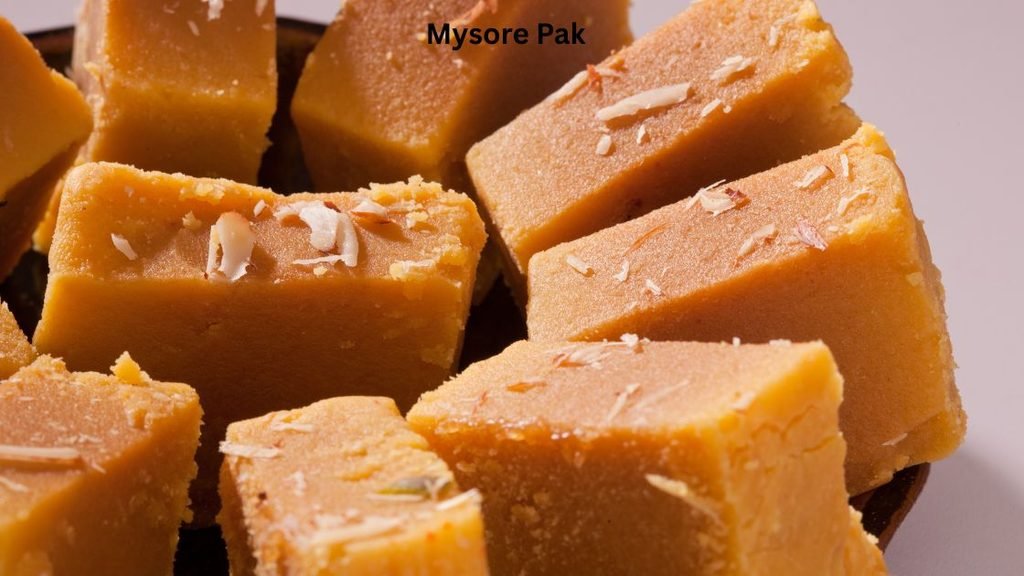
What is Mysore Pak?
Mysore pak is a rich, ghee-laden sweet made from besan (gram flour), sugar, and generous amounts of ghee, cooked together until it sets into a fudge-like or porous, melt-in-the-mouth texture depending on the style. There are two popular versions: the softer, more porous “ghee Mysore pak” and the firmer, denser “hard” version, both share the same three core ingredients but differ in cooking technique and ghee-to-oil ratio. Its buttery aroma and delicate crumb have made it one of South India’s most recognisable sweets.
Where Mysore Pak Comes From
Mysore pak was created in the royal kitchens of the Kingdom of Mysore, in present-day Karnataka, during the reign of Maharaja Krishna Raja Wadiyar IV in the early 20th century. According to popular tradition, the palace chef Kakasura Madappa experimented with besan, sugar, and ghee to create a new confection, and when the king asked its name, Madappa simply called it “Mysore Pak” after the city. It quickly spread beyond the palace and today is made across Karnataka and the rest of South India. People make it especially during festivals, weddings and celebrations like Diwali and Ganesh Chaturthi.
Health Benefits of Besan (Gram Flour)
Besan, the base of Mysore pak, is a nutritionally useful ingredient even in a sweet like this.
- It’s naturally gluten-free, making it suitable for those avoiding wheat.
- Besan is a good source of plant protein and fibre compared to refined flour.
- It has a lower glycemic index than maida, meaning it doesn’t spike blood sugar as sharply.
- Ghee, used generously here, provides fat-soluble vitamins A, D, E, and K and, in moderation, supports digestion.
Ingredients:
- 1 cup besan (gram flour), sifted
- 1 cup sugar
- 1/2 cup water
- 1 to 1.5 cups ghee, warmed (divided use)
- 1/4 teaspoon cardamom powder (optional)
Instructions:
Step 1: Sift the besan
Sift the besan two to three times to remove any lumps, this step directly affects how smooth the final texture turns out.
Step 2: Make the sugar syrup
In a heavy-bottomed pan, combine sugar and water and heat until it reaches a one-string consistency (when a drop between two fingers forms a single thin thread).
Step 3: Add the besan
Reduce the heat to low and gradually whisk in the sifted besan to avoid lumps, stirring continuously.
Step 4: Pour in ghee gradually
Start adding warm ghee, a few tablespoons at a time, while stirring constantly. As the mixture absorbs the ghee, it will start to bubble and rise, keep adding more ghee as it gets absorbed.
Step 5: Watch for the right consistency
Continue stirring on low-medium heat until the mixture starts leaving the sides of the pan and becomes frothy and light, almost like a batter that holds its shape briefly when dropped.
Step 6: Set and cut
Immediately pour the mixture into a greased tray, spreading it evenly. Let it sit for 2-3 minutes (not longer, or it’ll harden too much to cut cleanly), then cut into square or diamond pieces while still warm.
Tips:
Work quickly once you start pouring in the ghee, Mysore pak sets fast, and hesitating can leave you with a lumpy or unevenly cooked batch. Keep the ghee warm throughout the process, since cold ghee added to the hot besan mixture can cause it to seize.
Preparation Time
Prep: 10 minutes | Cook: 20 minutes | Total: about 30 minutes | Makes: about 20 pieces
Common Mistakes
- Adding cold ghee instead of warm, which causes the mixture to clump.
- Not sifting the besan, resulting in a grainy texture.
- Letting the syrup go past one-string consistency, which can make the final sweet too hard.
- Cutting the Mysore pak too late, after it has fully hardened in the tray.
Substitutions
For a slightly lighter version, some of the ghee can be replaced with a neutral oil, though this changes the classic aroma and texture. Jaggery can replace sugar for a more traditional, mineral-rich sweetness, though the colour and texture will differ slightly from the classic version.
Storage and Reheating
Mysore pak stores well in an airtight container at room temperature for up to a week, or refrigerated for up to two weeks. It doesn’t need reheating, in fact, it’s best enjoyed at room temperature so the ghee doesn’t turn grainy.
What to Serve With It
Mysore pak is typically served on its own as a festive sweet, alongside other mithai like kaju katli or besan ladoo during Diwali, weddings, or as prasad during festivals.
Frequently Asked Questions
Why did my Mysore pak turn out too hard?
This usually happens when the sugar syrup is cooked past one-string consistency or when too little ghee is used relative to besan.
Can I make the softer, porous version at home?
Yes, the porous texture comes from adding ghee at a higher temperature and in quicker succession, which traps air bubbles as the mixture rises.
Why is my Mysore pak greasy?
This can happen if too much ghee is added too quickly without giving the besan time to absorb it between additions.
Nutrition Information (approximate, per piece)
Calories: 150 | Protein: 2g | Carbohydrates: 14g | Fat: 10g | Fibre: 1g